11 Corporate Volunteering Ideas (and How to Choose the Right Ones for Your Program)

When it comes to corporate volunteering, many people assume that more options mean better outcomes. But the truth is, most organizations don’t struggle to come up with ideas. They struggle to choose the right ones for their workforce, their goals, and their level of program maturity.
For example:
- A skills-based volunteering program might deliver incredible impact but require more planning than your team can realistically support.
- A volunteer day could drive strong participation in one office but fall flat with a remote workforce.
- Some activities are easy to launch but difficult to scale; while others are measurable but only interest a small group of employees.
So, to help you decide which ones will work for you, we’ve created a list of 11 corporate volunteering activities for your team; as well as practical guidance on who it works for and key considerations before getting started.
Main Takeaways:
- The best volunteering activity isn’t necessarily the most popular. It’s the one that best aligns with your workforce, goals, and program maturity.
- Different volunteering opportunities deliver different outcomes, from increased engagement to leadership development and measurable community impact.
- Employee interests matter. Programs that align volunteering opportunities with causes employees care about often see stronger participation.
- A successful volunteering strategy balances accessibility, impact, and long-term sustainability rather than relying on one type of activity.
How to Choose the Right Volunteering Opportunity
Every volunteering activity delivers a slightly different outcome. Some are designed to maximize participation. Others are better suited to leadership development, ESG goals, or long-term community impact. Before choosing an activity, ask yourself a simple question: Which outcome matters most?
1. Start with your goal
If you want to:
- Increase participation: Prioritize team-based activities that are flexible, social, and easy to join.
- Demonstrate impact: Focus on more skills-based opportunities and/or long-term non-profit partnerships.
- Scale globally and engage remote teams: Offer flexible options with a mix of in-person and hybrid options.
2. Be realistic about constraints
- How much time can your team practically commit to? Is there more demand for short-term micro-volunteering events, or longer ongoing projects?
- How is your workforce set up? Do you need to accommodate for deskless employees or a hybrid set up? Are all offices local or global?
- What level of maturity is your program? Is corporate social impact new to your organization or a pivotal part of your company culture?
3. Consider employee interests and values
Employee participation is often stronger when opportunities align with causes employees already care about. This is particularly important as volunteering continues to shift toward more flexible and personalized experiences that align with employees’ specific interests, passions, and availability. To meet this need, gather insights from employee surveys, past impact data, key moments that matter and awareness days, as well as relevant industry findings, including the types of causes employees want to support.
Top Charity Cause Types for Volunteering
Since 2015, we’ve examined data from millions of employees within the CSR space. Here are some of the most popular cause types we’ve seen year-over-year.
- Human Services
- Education
- Public and Societal Benefit
- Environmental and Animals
- Health
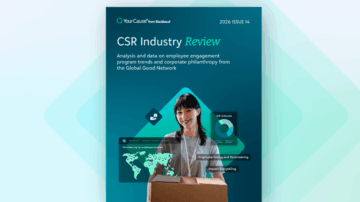
Looking for more insights like these? Explore the latest data in our Global CSR Industry Report.
4. Use these insights as a filter as you assess the ideas below.
The most successful volunteering programs are built around fit. Use your goals, constraints, and employee interests as a filter to assess which opportunities are most likely to succeed within your organization.
11 Corporate Volunteering Ideas to Engage Employees
1. Community Clean-Up Events
- Best for: Local teams, early-stage programs
- Participation type: Team
- Impact type: Environment and Animals
What makes it work:
Clean-up events are easy to understand, highly visible, and often require very little training. They’re particularly effective when teams volunteer together and can see the results of their work immediately.
What to keep in mind:
Many organizations treat clean-ups as one-off activities. Employees attend once, but participation decreases when the event becomes repetitive or disconnected from a broader volunteering strategy.
2. Food Bank Volunteering
- Best for: Large groups, first-time volunteers, local teams
- Participation type: Team
- Impact type: Human Services
What makes it work:
Food banks often offer structured volunteer opportunities that require minimal onboarding, making them easy for employees to participate in. Volunteers can immediately see the impact of their efforts, whether they’re sorting donations, preparing food parcels, or supporting distribution efforts.
What to keep in mind:
Food bank volunteering is often most successful as a group activity, but companies may encounter limited opportunities for larger events, particularly with popular food banks and during busy periods. Smaller teams, however, may find it easier to participate more regularly; while larger groups may need to plan further in advance to secure opportunities.
3. Care Package or Kit Assembly
- Best for: Large teams, office-based or distributed workforces
- Participation type: Team
- Impact type: Human Services / Health
What makes it work:
This activity is highly accessible and easy to scale. Not only can it happen in your office, which makes it easy for employees to join in; it’s also perfect for any experience level (especially first-time volunteers). To boost engagement, we recommend aligning your kits with key awareness days, moments that matter, and/or causes that matter most to your team.
Some options include:
- Hygiene kits
- School supply packs
- Winter care packages
- Disaster relief kits
- Pet shelter kits
What to keep in mind:
Without context, it can feel transactional. Employees often feel more engaged when they understand who they’re helping and why the items matter.
4. Skills-Based Volunteering
- Best for: Mature programs and knowledge-based workforces
- Participation type: Skills-based
- Impact type: Public and Societal Benefit / Economic Opportunity
What makes it work:
When employees use their professional expertise to support nonprofits, organizations often generate significant value while giving employees opportunities to develop and apply their skills in new environments and contexts. Nonprofit benefit by receiving expert help to address specific operational challenges, ranging from marketing plans and HR support to IT/technology implementation and financial guidance.
What to keep in mind:
Projects may stall or become overwhelming when expectations are too broad and/or unclear. Nonprofits may request support that expands beyond the team’s capacity, while volunteers may struggle to balance commitments alongside their day jobs.
5. Skills-Sharing Workshops
- Best for: Professional services, finance, technology, HR, and marketing teams
- Participation type: Skills-based
- Impact type: Education / Public & Societal Benefit
What makes it work:
Rather than completing work on behalf of a nonprofit (like you would during a skills-based volunteering activity), skills-sharing workshops allow employees to share knowledge that can help individuals or organizations build long-term capability. Examples include financial literacy workshops, CV reviews, interview coaching, or digital skills training.
What to keep in mind:
Workshops are most effective when topics align with genuine needs. Generic sessions may attract participation but deliver limited long-term value.
6. Virtual Mentoring or Tutoring
- Best for: Hybrid or global teams
- Participation type: Individual or small group
- Impact type: Education
What makes it work:
Virtual mentoring creates meaningful personal connections while removing geographic barriers. It can also fit more easily into an employee’s schedule than traditional volunteering.
What to keep in mind:
Participation might drop-off if sessions lack structure or regular scheduling.
7. Micro-Volunteering (bite-sized acts of kindness and other small tasks)
- Best for: Low participation environments
- Participation type: Individual
- Impact type: Varies by opportunity
What makes it work:
Industry trends suggest that volunteering is increasingly shifting toward shorter, more flexible opportunities that fit into busy schedules and diverse working environments. Employees who may never sign up for a full session are often willing to contribute 15-30 minutes and micro-volunteering enables that by offering a low barrier to entry and empowering them to contribute meaningfully without committing to a full volunteer day.
Activities may include mentoring a job seeker, reviewing a nonprofit’s marketing materials, writing letters to seniors, or even participating in a company-wide kindness campaign.
What to keep in mind:
Micro-volunteering can be difficult to connect to larger program goals if activities aren’t coordinated.
8. Environmental Action Campaigns (e.g., tree planting, sustainability challenges)
- Best for: Companies focused on ESG goals
- Participation type: Individual or team
- Impact type: Environment and Animals
What makes it work:
Employees can see a direct link between their volunteering efforts and broader sustainability commitments.
What to keep in mind:
Activities can feel disingenuous or symbolic if no measurable outcomes are shared – so it is important to tie each activity to measurable outcomes (e.g., trees planted, waste reduced) and share that impact post-event.
9. Employee-Led Volunteering
- Best for: Mature programs, organizations with active ERGs, companies focused on employee choice
- Participation type: Individual or Team
- Impact type: Varies by opportunity
What makes it work:
Internal benchmarking shows that companies that leverage Employee Resource Groups (ERGs) achieve nearly 2× the volunteer participation rates of companies without ERG involvement. This is likely because employees are often more deeply connected to causes that matter personally to them – which in turn leads to stronger engagement and a more diverse range of volunteering experiences.
What to keep in mind:
Employee-led volunteering naturally reflects the interests and passions of the people who participate. While this often leads to higher engagement, it can also make it harder to ensure opportunities align with broader organizational priorities or community impact goals. Establishing a few guiding principles can go a long way in helping to strike a balance between employee choice and program focus.
10. Charity Fundraising Challenges
- Best for: Distributed workforces, organizations seeking broad participation
- Participation type: Individual or Team
- Impact type: Varies by opportunity
What makes it work:
Fundraising walks, runs, cycling challenges, or awareness campaigns allow employees to support causes while creating friendly participation and shared goals. Activities can often be completed regardless of geography.
What to keep in mind:
Successful fundraising challenges don’t just rely on friendly competition to drive interest. Employees are often more motivated when they understand the impact they’re helping create; so be sure to connect fundraising goals back to the cause, charity, or community benefit throughout the campaign.
11. Board or Committee Service
- Best for: Senior leaders, emerging leaders, leadership development programs
- Participation type: Skills-based
- Impact type: Public and Societal Benefit
What makes it work:
Serving on a nonprofit board or committee allows employees to contribute strategic expertise while developing leadership, governance, and decision-making skills.
What to keep in mind:
Board service typically involves fewer participants than traditional volunteering activities, which can make it a less effective option if your primary goal is broad employee engagement. It tends to work best as part of a wider volunteering strategy that offers opportunities for employees at different levels and stages of their careers.
Best Practices for Building a Successful Volunteering Program
- Start with one or two activities rather than launching everything at once.
- Match opportunities to your workforce.
- Balance quick-win activities with longer-term impact opportunities.
- Regularly gather employee feedback to understand what’s working and where adjustments are needed.
- Measure participation and outcomes early so you can refine your program over time.
- Consider using purpose-built technology to reduce time-consuming tasks like promoting opportunities, coordinating registrations, tracking participation, and reporting outcomes for leadership and stakeholders.
So, Which Volunteering Opportunity Is Right for You?
If you’re still deciding where to begin, here’s a quick recap to help you match your goals with the types of opportunities most likely to deliver the outcomes you’re looking for.
| If your goal is… | Consider starting with… |
| Increase participation | Care Package or Kit Assembly, Food Bank Volunteering, Micro-Volunteering |
| Engage remote or distributed employees | Virtual Mentoring, Employee-Led Volunteering, Charity Fundraising Challenges |
| Support leadership development | Board or Committee Service, Skills-Based Volunteering |
| Build stronger team connections | Community Clean-Up Events, Food Bank Volunteering, Care Package Assembly |
| Align with ESG or sustainability goals | Environmental Action Campaigns, Community Clean-Up Events |
| Delivering lasting community value | Skills-Based Volunteering, Skills-Sharing Workshops |
| Give employees more choice and ownership | Employee-Led Volunteering, Micro-Volunteering |
| Develop long-term community relationships | Skills-Based Volunteering, Board or Committee Service |
But, remember, there is no single “best” volunteering activity.
The most effective programs aren’t necessarily the largest, most ambitious, or even the most expensive. They’re the ones that choose activities intentionally, align them with employee interests, and create experiences people genuinely want to return to.
So, whether you’re just getting started or looking to expand an existing program, focus on choosing a few opportunities that fit your workforce well, learn from employee feedback, and build from there.
And over time? Those individual activities can evolve into a volunteering program that drives participation, strengthens culture, and creates lasting community impact.
Topics

Turn Volunteering Ideas Into Measurable Impact
Identifying the right volunteering activities is a great start, but only one part of the equation. With YourCause’s volunteering platform, organizations can make it easier for employees to discover opportunities, participate in the causes they care about, and help program leaders track engagement and measure impact. Request a demo to learn how YourCause can help you build a more connected, scalable, and effective corporate volunteering program.


Frequently Asked Questions
-
Corporate volunteering is when a company supports employees in donating their time, skills, or expertise to charitable organisations, community groups, schools, or other causes. Activities can range from one-time volunteer days and fundraising events to skills-based volunteering and long-term nonprofit partnerships.
-
Corporate volunteering can strengthen employee engagement, build connections across teams, support leadership development, and help organisations create positive community impact. It also gives employees an opportunity to support causes that matter to them while developing new skills and experiences.
-
Some of the most common corporate volunteering activities include community clean-ups, food bank volunteering, care package assembly, skills-based volunteering, mentoring and tutoring, environmental campaigns, fundraising challenges, and employee-led volunteering initiatives.
-
Start by identifying your primary goal. If you’re looking to increase participation, low-barrier activities such as care package assembly or micro-volunteering may be a good fit. If you’re focused on measurable impact, skills-based volunteering or skills-sharing workshops may be more effective. It’s also important to consider employee interests, available resources, and how your workforce is structured.