2026 YourCause Global
CSR Industry Report
Chapter 5 Preview
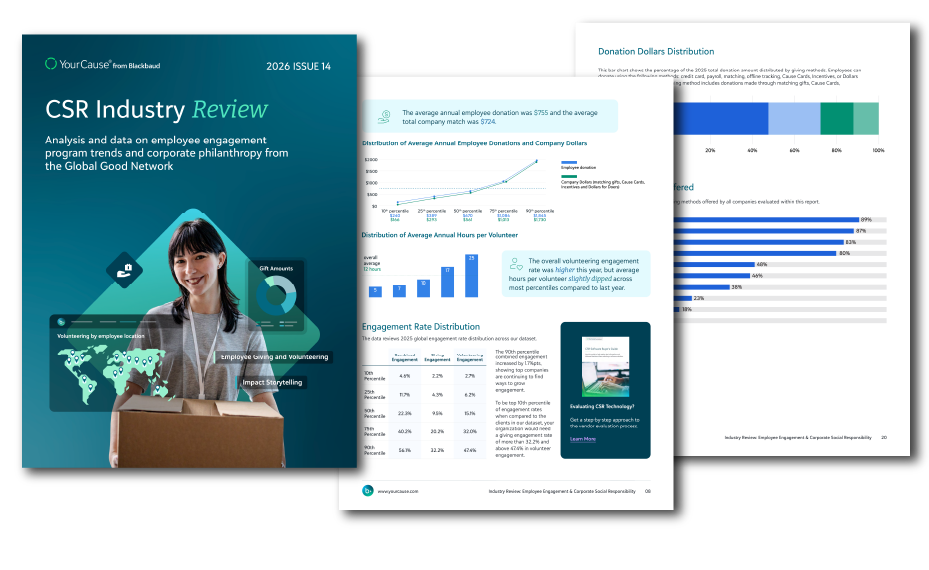
 Since 2015, the CSR Industry Review has been developed to provide corporations insight into employee engagement, corporate giving and grantmaking, community involvement, diversity and inclusion, and social responsibility.
Observations of key learnings and trends throughout this report were analyzed through data collected within the YourCause® CSRconnect® and GrantsConnect® platforms.
The 2026 report consolidates and details data collected between January and December 2025. Our team set out to identify shifts in employee philanthropic behavior, as well as trends in program elements offered by companies to their employee population. All findings are dispersed and shared with the employee and social responsibility community to ensure they are equipped with the latest research from this space.
This report continues to provide benchmarking data and insights that help companies large and small craft programs that fit into their organizational culture and drive employee engagement that creates social impact around the world.
Here is a sample of Chapter 5 of the report:
Industry Trends
Key Findings
- Finance and Insurance continue to lead in both giving and volunteering engagement.
The Finance and Insurance sector reported the highest engagement rates across both giving and volunteering, with increases in both areas year over year. This sustained leadership highlights the strength of well-established programs and a continued emphasis on employee participation within the industry. - Wholesale Trade and Manufacturing industries see large donation growth.
Wholesale Trade and Manufacturing saw the strongest growth in average donation per donor, indicating increasing employee generosity in these sectors and showing that other industries are also driving meaningful gains in their social impact programs.
Engagement by Industry
Companies have been categorized according to the North American Industry Classification System (NAICS). The data covers the top eight industries from the participating companies in this report.
| n = number of companies | Employee Sample Size |
Combined Engagement |
Donation Engagement |
Volunteer Engagement |
Avg. / Median Employee Donation | Avg. / Median Company Match | Avg. / Median Volunteer Hours |
|---|---|---|---|---|---|---|---|
| Finance and Insurance n = 99 |
913,390 | 28.0% | 14.1% | 23.1% | $1,035 $200 |
$770 $120 |
14.1 4.5 |
| Manufacturing n = 60 |
15,50,876 | 13.1% | 7.3% | 13.0% | $1,139 $250 |
$1,012 $250 |
16.8 3.5 |
| Professional, Scientific, and Technical Services n = 26 |
937,809 | 22.0% | 13.4% | 10.8% | $972 $100 |
$462 $35 |
5.9 3 |
| Wholesale Trade n = 17 |
3,52,912 | 9.9% | 4.6% | 8.0% | $829 $200 |
$715 $152 |
10 3 |
| Information n = 20 |
118,885 | 12.9% | 7.9% | 16.5% | $525 $200 |
$439 $200 |
11 8 |
| Retail Trade n = 13 |
6,58,552 | 13.3% | 3.6% | 12.2% | $387 $100 |
$474 $100 |
8.7 3 |
Utilities n = 16 |
1,94,530 | 20.7% | 13.5% | 12.7% | $801 $260 |
$970 $500 |
18.9 4 |
Health Care and Social Assistance n = 13 |
12,00,858 | 13.80% | 9.1% | 6.2% | $235 $52 |
$261 $75 |
12.3 4 |
Finance and Insurance companies lead in giving and volunteer engagement rates. Employees in the finance and insurance industry have the highest giving engagement rate at 14.1% and volunteer engagement rate at 28.0%, which is an increase of 1.1%pts and 3.4%pts respectively, compared to last year.
Before diving into the best practices of accounting for restricted funding, it’s important to understand the foundation it’s built on: fund accounting.
Fund accounting is the financial framework that sets social impact organizations apart from for-profit businesses. Instead of focusing on profitability, organizations prioritize mission fulfillment and accountability. Fund accounting enables organizations to segregate resources by purpose—such as general operations, restricted grants, or donor-designated funds—so every dollar is tracked according to its intended use within one system. No army of spreadsheets to track specific grants and programs.
The fund accounting approach is essential because nonprofits, foundations, agencies, and educational institutions often manage multiple revenue streams with unique restrictions. Donors and grantors expect transparency and proof that their contributions are used as promised. Fund accounting systems make this possible by recording transactions within self-balancing funds and ensuring compliance with regulations like FASB’s ASU 958 and GASB Statement No. 34, which requires clear reporting of net assets with and without donor or funder restrictions.